
What Do Credit Repair Companies Do — And Should You Hire One?
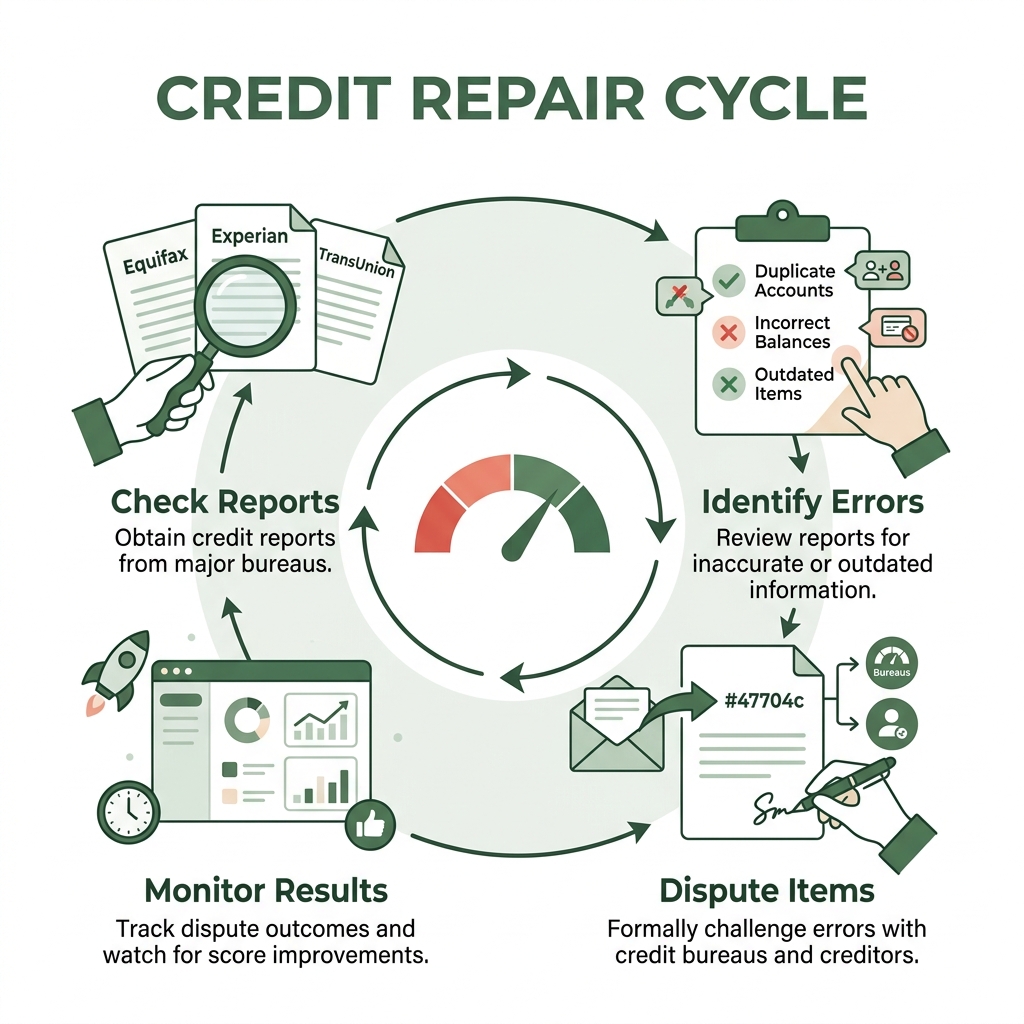
What do credit repair companies do can be answered simply: they review your credit reports, identify errors or unverifiable information, and dispute those items with the credit bureaus on your behalf.
Here’s a quick breakdown:
- Review your credit reports from Equifax, Experian, and TransUnion
- Identify errors like duplicate accounts, wrong balances, or outdated negative items
- Send dispute letters to credit bureaus and creditors
- Negotiate with creditors to remove or correct inaccurate information
- Monitor your reports to make sure removed items don’t reappear
- Educate you on habits that can improve your score over time
Note: Credit repair companies cannot legally remove accurate, current negative information — only errors, outdated items, or unverifiable data.
If you’ve been denied a loan, stuck with sky-high interest rates, or just feel like your credit score is working against you — you’re not alone. Millions of Americans are in the same position.
The credit repair industry promises to help. But it’s also an industry where more than half of consumer complaints filed with the CFPB cite fraud or scam. That’s a big red flag you can’t ignore.
So the real question isn’t just what credit repair companies do. It’s which ones actually help, which ones hurt, and how to tell the difference.
That’s exactly what this guide covers.
What Do Credit Repair Companies Do to Improve Your Score?

At its core, credit repair is the process of fixing a credit history that has been marred by inaccuracies, identity theft, or outdated information. When you hire a professional, you are essentially paying for an advocate who understands the complex language of the credit bureaus.
The first step in how credit repair works involves a deep dive into your financial past. We look at your history not just as a number, but as a story. Sometimes that story has “typos” that are costing you thousands of dollars in interest. At United Credit Experts, we believe in simplifying this process so you aren’t just getting a fix, but an education.
What do credit repair companies do to identify report errors?
You might think your credit report is an airtight legal document, but the reality is much sloppier. A landmark Consumer Reports study on credit errors found that a staggering 44 percent of people who accessed their reports found at least one error.
When we analyze your reports, we are looking for specific red flags:
- Duplicate Accounts: Sometimes a debt is sold from one collector to another, and both end up reporting the same debt, making it look like you owe twice as much as you do.
- Incorrect Balances: Your “amounts owed” makes up 30% of your FICO score. If a credit card company reports a $5,000 balance on a card you’ve paid down to $500, your score takes a massive hit.
- Outdated Information: Most negative information must be removed after seven years. If a late payment from 2015 is still hanging around, it’s illegal, and it needs to go.
- Identity Errors: Mixed files (where someone with a similar name has their bad habits attached to your report) are more common than you’d think in places like Northwest Indiana and across the country.
What do credit repair companies do during the dispute process?
Once an error is found, the heavy lifting begins. We don’t just “ask” for it to be removed; we use your Fair Credit Reporting Act (FCRA) rights to demand accuracy.
The process typically follows a 30-day investigation window. When a dispute is filed, the credit bureau has about 30 to 45 days to investigate. They must contact the “furnisher” (the bank or collection agency that reported the info). If the furnisher cannot verify that the information is 100% accurate and timely, the bureau is legally required to delete it.
The Legal Landscape: What Companies Can and Cannot Do
The credit repair industry isn’t the Wild West; there are strict federal laws in place to protect you. The most important is the Credit Repair Organizations Act (CROA).
Under CROA, any legitimate company must:
- Provide you with a written contract before any work begins.
- Give you a 3-day cancellation right, allowing you to back out of the contract without paying a dime.
- Be transparent about the total cost and the estimated timeframe for results.
Furthermore, if a company is helping you deal with aggressive debt collectors, they must also adhere to the Fair Debt Collection Practices Act (FDCPA), which prevents collectors from using abusive or deceptive tactics to collect a debt.
Prohibited Actions and Legal Limits
It is vital to understand that even the best credit repair company has limits. If you missed a payment last month and the bank reported it correctly, no one can legally wave a magic wand and make it disappear.
Here is what is strictly illegal for a credit repair company to do:
- Upfront Fees: This is the big one. It is illegal for a company to charge you before they have fully performed the promised services. The CFPB $2.7 billion settlement in 2023 against major industry players was largely due to companies illegally charging fees before proving results.
- Guaranteeing Results: No one can guarantee a specific score increase (like “we’ll boost you 100 points in 30 days”).
- Removing Accurate Info: If the negative mark is true, verified, and within the legal reporting limit (7 years for most items, 10 years for Chapter 7 bankruptcy), it stays.
- False Claims: They cannot advise you to lie to a credit bureau or change your identity to get a “fresh start.”
Spotting the “Ugly”: Signs of a Credit Repair Scam
Because people seeking credit repair are often in a vulnerable financial position, scammers frequent this industry. In fact, the CFPB reports that more than half of all credit repair complaints involve “fraud or scam” allegations.
Knowing the warning signs can save you from losing your hard-earned money. If you encounter a company that does any of the following, report the fraud to the FTC immediately.
Common Fraudulent Tactics
Scammers use specific “hooks” to reel people in. Be on high alert for:
- Credit Privacy Numbers (CPN): This is a huge red flag. Scammers may tell you to apply for a CPN or an EIN (Employer Identification Number) to use instead of your Social Security Number. They claim it’s a “new credit identity.” This is a federal crime. Using a fake number to apply for credit is bank fraud.
- Untraceable Payments: If a company asks you to pay via wiring money, cryptocurrency, or by putting money on a gift card, run the other way. Legitimate businesses use standard payment processing.
- The “Don’t Contact Bureaus” Rule: If a company tells you not to contact the credit bureaus yourself, they are likely trying to hide their deceptive tactics from the regulators. You always have the right to contact the bureaus directly.
- Guaranteed Deletions: As mentioned, if they promise to remove that 2-year-old bankruptcy that you definitely filed, they are lying to you.
Professional Credit Repair: Is It Worth the Investment?
You might be wondering: “If I have the legal right to do this myself, why should I pay someone else?” It’s a fair question. You can technically change your own oil, represent yourself in court, or do your own taxes—but most people hire professionals for the expertise and the time saved.
The DIY route requires you to:
- Pull all three reports (which you can do for free at AnnualCreditReport.com).
- Categorize every single line item.
- Write individual dispute letters for every error.
- Track the 30-day deadlines for each bureau.
- Provide evidence (bank statements, receipts, etc.) for every claim.
- Follow up when the bureaus inevitably send back a “verified” response.
Professional services typically cost between $50 and $150 per month, or sometimes a “pay-per-delete” fee (often around $100 per deleted item). For many in Crown Point or the surrounding Indiana area, the cost is worth it to ensure the job is done right the first time and to avoid the massive headache of bureaucratic paperwork.
Complementary Strategies for Credit Improvement
Credit repair is only half the battle. While we work on removing the “bad” stuff, you must work on building the “good” stuff. This is what we call the ABCs of credit.
- Payment History (35%): This is the king of your score. One 30-day late payment can drop a good score by 100 points. Always pay on time, even if it’s just the minimum.
- Credit Utilization (30%): Keep your balances below 30% of your limit. If you have a $1,000 limit, try not to owe more than $300 at any given time.
- Identity Theft Protection: If your score dropped suddenly and you haven’t missed a payment, check IdentityTheft.gov immediately. You may be a victim of fraud, which requires a specialized recovery plan.
Frequently Asked Questions about Credit Repair
How long does credit repair take?
There is no “quick fix.” While some errors can be corrected in a single 30-day cycle, most people see significant results within 3 to 6 months. The timeline depends on how many items are being disputed and how quickly the creditors respond. If a bureau asks for more information, the clock can reset, adding another 30 days to the process.
What do credit repair companies do if they find accurate negative info?
If a negative item is accurate, we can’t just “delete” it, but we can look for other avenues.
- Goodwill Letters: We can help you draft a letter to a creditor asking them to remove a single late payment as a gesture of “goodwill” because you’ve been a loyal customer.
- Pay-for-Delete: In some cases, a collection agency might agree to stop reporting a debt if you pay it in full.
- Education: We help you understand collections and scores so you know exactly when that negative info will naturally fall off your report (usually 7 years).
Can I repair my credit for free?
Yes, you absolutely can. Federal law gives you the right to dispute any inaccuracy on your own. You can visit AnnualCreditReport.com to get your reports and start the process today.
However, the “free” route often comes with a high “time cost.” Many people start the DIY process but give up when the credit bureaus send back complicated form letters. Professional expertise provides the persistence and technical knowledge needed to navigate those roadblocks efficiently.
Conclusion
At United Credit Experts, we don’t just want to “fix” a number; we want to change your financial destiny. Whether you are in Northwest Indiana or anywhere else in the state, understanding your credit is the first step toward true financial freedom.
Credit repair isn’t magic—it’s a combination of legal rights, persistent effort, and financial education. By removing the “ugly” errors from your past and building “good” habits for your future, you can take control of your financial life.
Ready to take the first step? Start your credit education process today and let us help you simplify the path to a better score.