
Your Credit Score Doesn’t Have to Stay Stuck

The best credit recovery programs can make the difference between getting approved for a home loan or being turned away — again.
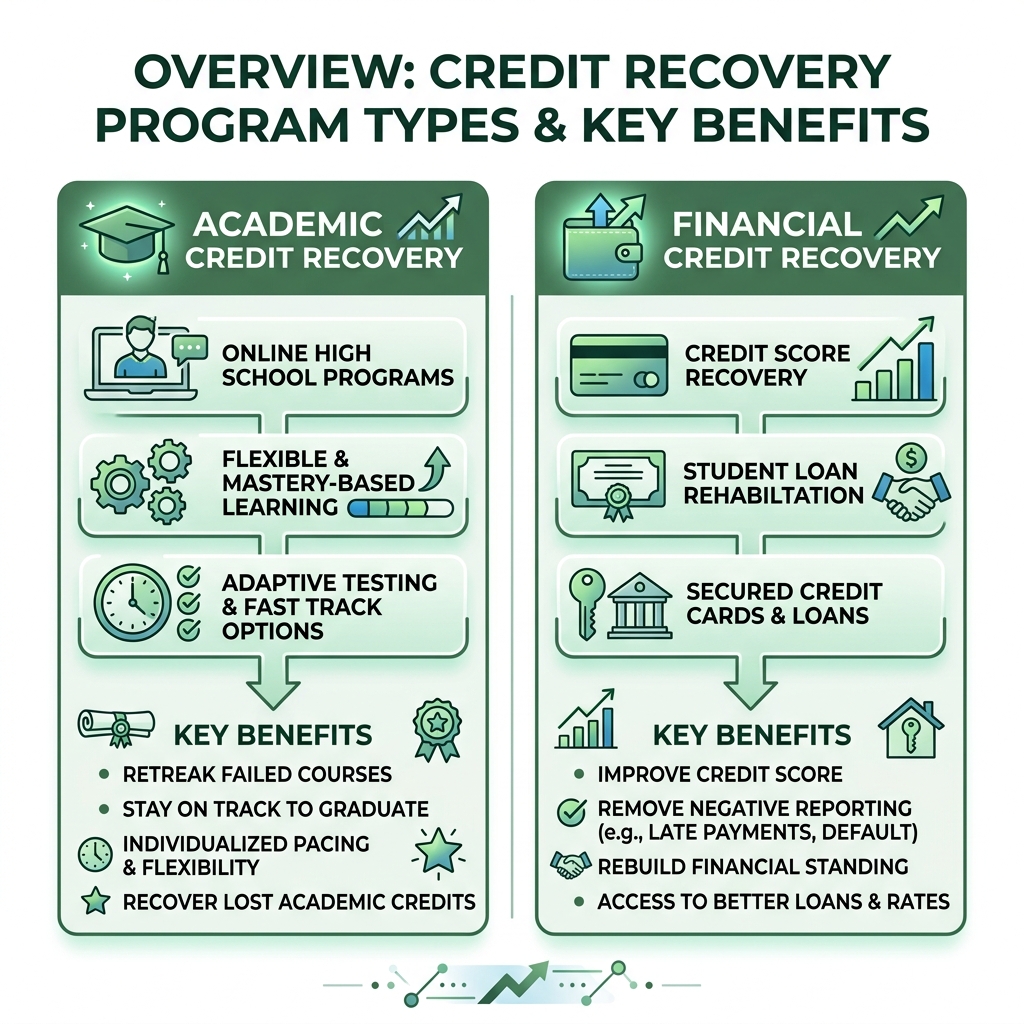
Whether you’re dealing with a damaged credit score, defaulted student loans, or a high school student who needs to retake a failed course, there are structured programs designed to help you get back on track.
Here’s a quick look at the top options:
| Program Type | Best For | Key Feature |
|---|---|---|
| Online High School Credit Recovery | Students who failed a course | Self-paced, enroll anytime |
| K12 Online Credit Recovery | Flexible high school students | Adaptive, mastery-based learning |
| Keystone School Credit Recovery | Grades 6-12, online or print | Complete in as little as 4 weeks |
| Accelerate Online Academy | Students needing adaptive testing | Test out of mastered sections |
| Silicon Valley High (AlwaysOnline) | Schools needing fast setup | Live in 2 days, AI-powered support |
| Fresh Start Initiative | Defaulted federal student loan borrowers | Wipes negative credit reporting |
| Imagine Edgenuity | At-risk and AP students | Research-backed, standards-aligned |
Poor credit doesn’t just hurt your feelings — it costs you real money. Higher interest rates. Loan denials. Getting stuck renting when you want to own.
The good news? Recovery is possible, and faster than most people think.
Below, we break down the programs that actually work — for students trying to graduate on time and for adults trying to rebuild their financial standing.
What is a High School Credit Recovery Program?

At its heart, a high school credit recovery program is a second chance. We often see students who have faced “learning loss” or personal hurdles that prevented them from passing a core requirement the first time around. Instead of forcing a student to repeat an entire academic year or sit through a full-length 18-week course for a subject they partially understand, these programs focus on the specific gaps in their knowledge.
These programs are primarily designed for at-risk students who need to meet graduation requirements to stay on track with their peers. Whether the failure was due to illness, family instability, or simply a difficult subject, the best credit recovery programs provide a bridge back to academic success.
Key features of these programs include:
- Personalized Instruction: Rather than a “one-size-fits-all” classroom, the curriculum is tailored to what the student actually needs to learn.
- Self-Paced Learning: Students can move quickly through material they understand and take extra time on the concepts that tripped them up previously.
- Targeted Units: Many modern programs use “adaptive release,” meaning students focus only on unmastered material.
Comparing Formats: Online vs. Print
While most of us think of digital learning first, some reputable programs still offer print-based options, which can be a lifesaver for students with limited internet access or those who learn better with physical materials.
| Feature | Online Format | Print Format |
|---|---|---|
| Typical Duration | 4 to 8 weeks | Varies (often 30-45 hours of study) |
| Availability | 24/7 access from any device | Physical booklets and mail-in exams |
| Support | Real-time AI and teacher chat | Phone or email support |
| Best For | Tech-savvy, independent learners | Students in remote areas or those needing tactile study |
Choosing the Best Credit Recovery Programs for Your Needs
Selecting a program isn’t just about finding the cheapest price or the fastest completion time. If the credits don’t transfer back to your local school in Crown Point or Northwest Indiana, the effort is wasted.
When we advise families on choosing a path, we suggest looking at these critical factors:
- Accreditation: Ensure the program is accredited by recognized bodies like Cognia or WASC. This ensures the quality of education and the validity of the diploma.
- NCAA Eligibility: This is huge for student-athletes. If a student-athlete takes a credit recovery course that isn’t NCAA-approved, they could lose their eligibility for college sports.
- Counselor Approval: Never enroll without a green light from your school counselor. They are the gatekeepers who decide if the outside credit will be accepted on the official transcript.
- Transferability: Check if the program provides official transcripts that your home school can easily process.
- Tuition Models: Costs vary. Some programs charge per semester (e.g., $116–$129), while others offer a full-year “bundle” for a discount (around $155–$169).
For those interested in how these programs impact long-term success, you can explore the Latest research on credit recovery impact, which highlights how research-based curricula help students meet their academic goals.
Core Subjects in the Best Credit Recovery Programs
You aren’t limited to just “the basics.” While most students use these programs for core requirements, the variety is impressive:
- Mathematics: Algebra 1 & 2, Geometry, and Business Math.
- Science: Biology, Chemistry, and Earth Science.
- Humanities: U.S. History, English Language Arts, and Civics.
- World Languages: Spanish is the most common, often aligned with national standards.
- Advanced Options: Some programs even offer Advanced Placement (AP) and electives to help boost a GPA while recovering a credit.
Support Systems in the Best Credit Recovery Programs
One common fear is that “online” means “alone.” That couldn’t be further from the truth in high-quality programs. The best credit recovery programs offer:
- Certified Teachers: Real human beings who grade assignments and provide feedback.
- 1:1 Tutoring: On-demand help when a student gets stuck on a specific problem.
- AI Assistants: Some programs now use AI tutors that are available 24/7 to answer immediate questions.
- Progress Dashboards: These allow parents and school administrators to see exactly how much of the course is finished in real-time.
How Online Credit Recovery Programs Typically Work
The process is designed to be as frictionless as possible. Usually, it starts with a “diagnostic test.” This pre-test identifies what the student already knows. If they show mastery of the first two units of Algebra, the program might let them “test out” of those sections, allowing them to focus exclusively on the areas where they failed.
Most courses are broken into 60-hour modules per semester. While a traditional school semester takes 18 weeks, a dedicated student in a credit recovery program can often finish in 4 to 8 weeks. Enrollment is typically “rolling,” meaning you don’t have to wait for summer school to start; you can begin on a Tuesday in October if that’s when you need it.
Flexible Features for Unique Student Circumstances
We know that life in Indiana doesn’t always follow a 9-to-5 schedule. Credit recovery is often the only way for certain students to graduate:
- Student-Athletes: Those with heavy practice and travel schedules can fit their “seat time” in during evenings or weekends.
- Family Breadwinners: Students who work part-time to help their families can study late at night or early in the morning.
- Learning Challenges: Programs often accommodate IEP or 504 plans, providing the extra time or modified instruction a student needs to thrive.
- Blended Learning: Some local schools use these online platforms inside a physical classroom, giving students the best of both worlds: digital content with a teacher physically present to help.
Financial Credit Recovery and the Fresh Start Initiative
At United Credit Experts, we believe in empowering you through education—and that includes understanding how to recover your financial “credits.” Just as a student can recover a failed class, a borrower can recover from a defaulted student loan.
The U.S. Department of Education recently introduced a major “credit recovery” tool for adults: the Fresh Start Initiative. This is a one-time program designed to help defaulted federal student loan borrowers get back into good standing.
If you have federal loans that went into default before the pandemic pause (March 13, 2020), this initiative is a game-changer. Here is why it matters for your credit score:
- Negative Reporting Removed: The “default” status is removed from your credit report.
- Restored Eligibility: You regain access to federal student aid (Pell Grants and further loans) if you want to go back to school.
- Stopped Collections: It puts a halt to involuntary collections like wage garnishments or the taking of tax refunds.
- Access to Income-Driven Repayment: You can move your loans into a plan that bases your monthly payment on what you actually earn, sometimes as low as $0 per month.
For the official details, you can view the Fresh Start Initiative Fact Sheet. According to the Department of Education Fresh Start Announcement, this initiative aims to eliminate the long-term negative effects of default for millions of borrowers.
Frequently Asked Questions about Credit Recovery
Who is eligible for the Fresh Start student loan program?
Borrowers with defaulted federal student loans (specifically FFEL and Direct Loans) that defaulted prior to the pandemic payment pause are generally eligible. You usually have to “opt-in” by contacting the agency holding your loan to ask for the transfer to a regular servicer.
How long does it take to complete an online credit recovery course?
While it depends on the student’s pace, most programs have a minimum duration of 4 weeks and a maximum of about 8 to 20 weeks. If a student is highly motivated and only needs to cover a few unmastered units, they can often finish much faster than a traditional classroom setting allows.
Are credits earned in these programs recognized by colleges?
Yes, provided the program is accredited. Most colleges and universities accept credits from accredited online providers just as they would from a traditional high school. However, we always recommend checking with the specific college’s admissions office if you are aiming for a highly competitive school.
Conclusion
Whether you are a high schooler in Crown Point trying to make sure you walk across that stage with your friends, or an adult in Northwest Indiana looking to wipe a default off your credit report, recovery is within reach. The best credit recovery programs are those that offer flexibility, support, and a clear path to the finish line.
At United Credit Experts, we are passionate about credit education. We define credit simply: it’s money lent to you that you agree to pay back later. When that process breaks down, it doesn’t have to be the end of your financial story. By using structured recovery programs—academic or financial—you can rebuild your foundation and open doors that previously seemed locked.
If you are ready to take the next step in your journey toward financial or academic clarity, we invite you to learn More info about our process. Let’s work together to ensure your score—and your future—never flatlines.