
Is Debt Settlement Actually Worth the 25 Percent Fee?
Debt settlement is a service that negotiates with creditors to reduce what you owe on unsecured debts like credit cards and personal loans. Before enrolling in any program, it is vital to understand your rights as outlined by the Federal Trade Commission (FTC).
| Question | Quick Answer |
|---|---|
| Is debt settlement legitimate? | It can be, when offered by properly accredited and compliant firms |
| Average savings | Often around 50% before fees, but results vary |
| Service fee | Often 22-25% of total enrolled debt |
| Minimum debt required | Often $7,500 in unsecured debt |
| Program length | Typically 24-36 months |
| Available in | Varies by provider and state |
| Upfront fees | None – fees are generally charged only after settlement |
If you’re buried in credit card debt and struggling to keep up with minimum payments, you’ve probably seen ads promising to cut your debt in half. Debt settlement companies are among the most visible businesses making that promise.
Some providers have been around for years, settled large numbers of accounts, and built strong online review profiles. That can be encouraging – but it does not automatically mean the service is the right fit for every consumer.
The biggest catch is usually the fee: it can reach 25% of your total enrolled debt. On a $25,000 debt load, that’s up to $6,250 in fees alone.
So the real question isn’t just “does it work?” – it’s “does it work well enough to justify the cost?”
This review breaks down exactly how debt settlement works, what it can cost, who it may be right for, and what risks you need to understand before signing up.
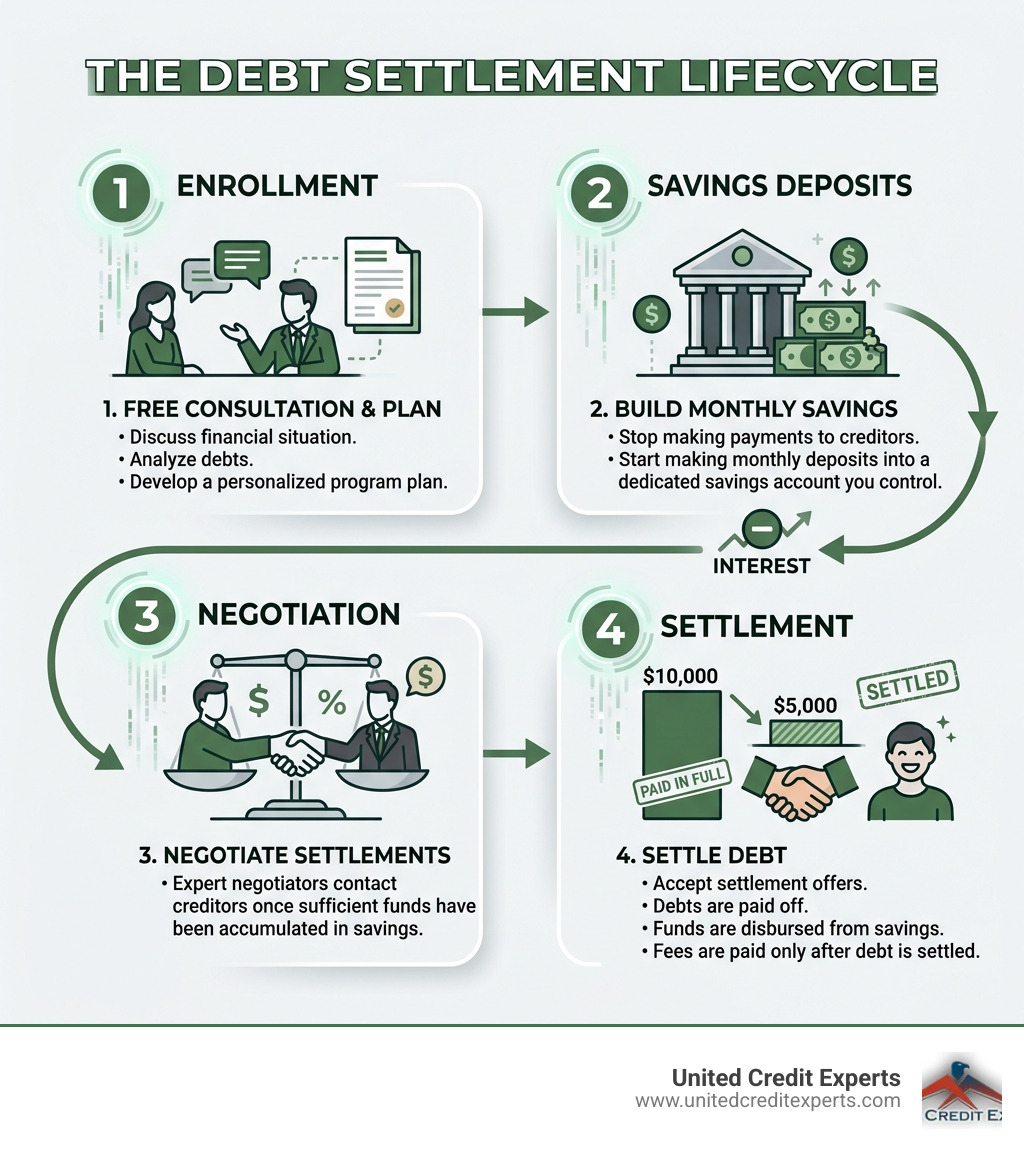
How the Program Works Step-by-Step
Understanding the mechanics of debt settlement is vital because it isn’t a loan. It is a performance-based negotiation process. At United Credit Experts, we believe in simplifying the “scary” parts of finance. Think of this program as a middleman that steps between you and the banks to haggle for a better deal.
Here is the step-by-step journey:
1. The Free Consultation and Debt Assessment
The process begins with a consultation where a representative reviews your financial health. They look for “unsecured debt” – money you’ve borrowed that isn’t backed by collateral like a house or a car. This includes credit cards, medical bills, and private student loans. To qualify, you generally need at least $7,500 in debt and a documented financial hardship like a job loss or medical emergency.
2. Setting Up the Special Savings Account
Once enrolled, you stop paying your creditors directly. Instead, you open a dedicated, FDIC-insured savings account that you own and control. You make one monthly deposit into this account. Usually, this deposit is significantly lower than the combined minimum payments you were struggling to pay before.
3. The Negotiation Phase
As your savings grow, the negotiators reach out to your creditors. They use the lump sum sitting in your account as leverage. They essentially tell the bank, “Our client can’t pay the full $10,000, but they have $5,000 ready right now. Will you take it and close the account?”
4. The Lump-Sum Settlement
When a creditor agrees to a reduced amount, you are notified. You must approve every settlement before any money leaves your account. Once you say yes, the creditor is paid, the debt is marked as “settled for less than the full balance,” and the service fee is taken.
It is important to remember that during this time, your accounts will likely go into default if they aren’t there already. This has a major impact on your report. For more on how this looks on your history, check out our guide on Collections and Credit Scores.

Analyzing the Costs and Fees
The most controversial part of debt settlement is the fee structure. While settlement companies do not charge upfront fees for successful settlements, the success fees can still be steep.
The 22-25% Service Fee
This fee is calculated based on the total debt you enroll, not the amount saved. This is a crucial distinction. If you enroll $20,000 in debt, a 25% fee is $5,000, regardless of whether that debt is settled for $10,000 or $15,000.
| Enrolled Debt | Estimated Settlement (50%) | Service Fee (25% of Enrolled) | Total Cost to You | Your Net Savings |
|---|---|---|---|---|
| $10,000 | $5,000 | $2,500 | $7,500 | $2,500 (25%) |
| $25,000 | $12,500 | $6,250 | $18,750 | $6,250 (25%) |
| $50,000 | $25,000 | $12,500 | $37,500 | $12,500 (25%) |
Other Potential Costs
- Monthly Account Fees: There is typically a small monthly fee, often around $9-$10, to maintain the dedicated savings account.
- Setup Fees: Some accounts may have a one-time setup fee for the banking platform.
- Accrued Interest: Because you stop paying your creditors during the program, interest and late fees continue to pile up. This means the balance being negotiated might be higher than the balance you started with.
We often see people surprised by how aggressive collection efforts can get once payments stop. To see a humorous but informative take on how these companies operate, you might enjoy this breakdown of Collection Companies with John Oliver.
Eligibility and Risks of debt settlement
Is everyone a candidate for this type of program? Not necessarily. At United Credit Experts, we want you to have the full picture, including the fine-print risks that promotional ads often gloss over.
Eligibility Requirements
- Minimum Debt: Many programs require at least $7,500 in unsecured debt.
- Type of Debt: Only unsecured debt qualifies. You generally cannot settle a mortgage, an auto loan unless the car was repossessed, or federal student loans.
- Financial Hardship: You typically must demonstrate that you cannot afford your current payments.
- Location: Availability depends on state law and the specific provider.
The Real Risks
- Credit Score Impact: Your credit score will drop – often significantly. By stopping payments to save for settlements, you are intentionally defaulting on your obligations. These marks stay on your credit report for seven years.
- Lawsuit Risks: Creditors are not legally required to settle. Some may choose to sue you for the full balance plus legal fees. A settlement company may provide negotiation support, but unless it is a law firm, it cannot represent you in court.
- Tax Implications: The Internal Revenue Service (IRS) views forgiven debt as taxable income. If you settle a $10,000 debt for $5,000, that $5,000 savings may be reported to the IRS on a 1099-C form, and you might owe taxes on it unless you can prove you were insolvent at the time.
- No Guarantees: There is no guarantee that every creditor will settle. If a major creditor refuses, you could spend years in a program and still owe a large balance.
Before you jump in, it is vital to know your rights under the Fair Debt Collection Practices Act FDCPA and the Know Your Rights FCRA. These laws protect you from harassment and help ensure your credit information is handled accurately.
Frequently Asked Questions
When researching debt settlement, consumers often have the same burning questions. Here is the expert take on the most common inquiries.
How long does a debt settlement program take?
Most clients are told the program takes 24 to 36 months, though some can take up to 48 months. The speed of your debt-free journey depends on three things:
- Your Monthly Deposit: The more you can save each month, the faster negotiators have the cash in hand to make offers.
- Creditor Behavior: Some banks are quick to settle; others wait until the debt is very old or sold to a third-party collector.
- Total Debt Amount: More accounts mean more individual negotiations, which takes time.
Is debt settlement available in my state?
Many debt settlement services operate in multiple states, but availability varies based on licensing rules and fee regulations. Some states have strict caps on fees or other legal requirements that limit where these programs can operate.
What happens if a creditor refuses to settle?
This is a common fear. If a creditor refuses to settle or decides to take legal action, the account may need to be prioritized for negotiation. However, if they still will not budge, you may have to deal with that specific debt through other means, such as a debt management plan or, in extreme cases, bankruptcy.
For more information on dealing with specific types of debt collectors, you can browse our Category Collections section.
Conclusion
So, is debt settlement worth a 25% fee?
The answer depends on your alternative. If you are currently paying 29% interest on $30,000 of debt and only making minimum payments, you could end up paying back far more over many years. In that context, paying a sizable fee to settle the debt in three years may still be a meaningful win.
However, if you have a decent credit score and could qualify for a low-interest consolidation loan, that is often a better, cheaper, and safer option.
At United Credit Experts, we believe that education is the ultimate financial tool. Whether you choose debt settlement, a debt management plan, or a DIY approach, the goal is to stop the cycle of borrowing and start the journey toward empowerment.
If you’re ready to take the next step and want to understand how to rebuild your financial life from the ground up, we are here to help. Start your credit journey with us today and learn how to master the basics of credit so you never have to face a debt crisis again.