
Why the Education Tax Act Matters for Your Finances

The education tax act refers to the federal tax laws and IRS provisions that let students, parents, and workers reduce what they owe — or even get money back — for education costs.
Here’s a quick overview of the main benefits available:
| Benefit | What It Does | Max Amount |
|---|---|---|
| American Opportunity Tax Credit (AOTC) | Reduces tax owed; partially refundable | Up to $2,500 per student |
| Lifetime Learning Credit (LLC) | Reduces tax owed; non-refundable | Up to $2,000 per return |
| Student Loan Interest Deduction | Lowers taxable income | Up to $2,500 per year |
| 529 Plan | Tax-free growth for education savings | Varies by state |
| Coverdell ESA | Tax-free savings for K-12 and college | Up to $2,000/year contributed |
A year at a four-year college now costs well over $30,000 on average — and that number keeps climbing. For anyone already dealing with tight finances, high interest rates, or debt, that burden can feel impossible.
The good news? The tax code has real tools built in to help offset those costs. But most people either don’t know they exist, or they make small mistakes that cost them hundreds — or even thousands — of dollars.
This guide breaks down every major education tax benefit in plain language, so you can stop leaving money on the table.
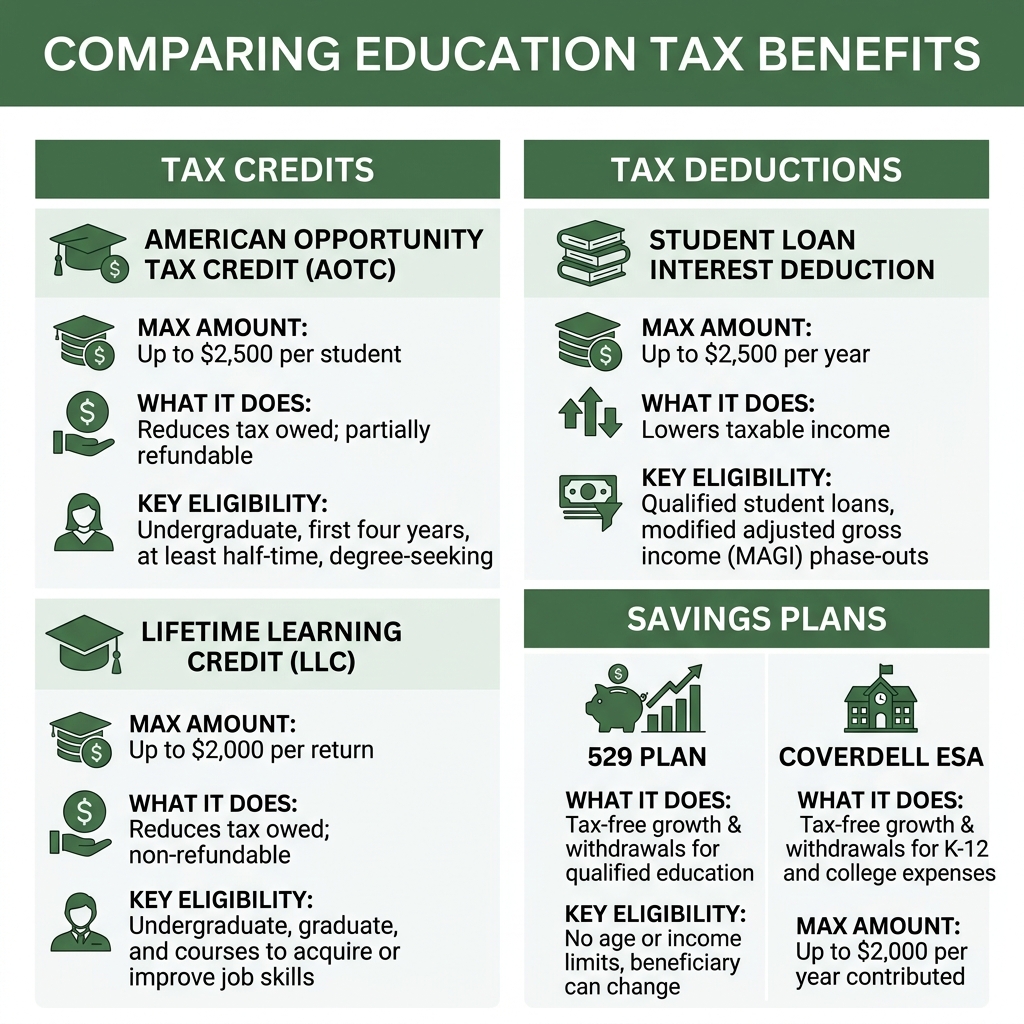
Navigating the Education Tax Act: Credits vs. Deductions
When we talk about the education tax act, we often hear the terms “credit” and “deduction” used interchangeably. However, in taxes, they are as different as a discount coupon and a lower price tag. Understanding the difference is the first step toward mastering your financial future.
The Breakdown of Benefits
To help our clients at United Credit Experts navigate these waters, we like to simplify the terminology:
- Tax Credit: This is the “Gold Standard.” A tax credit reduces the actual amount of tax you owe, dollar-for-dollar. If you owe $3,000 in taxes and qualify for a $2,500 credit, your tax bill drops to $500.
- Tax Deduction: This reduces the amount of your income that is subject to tax. If you earned $50,000 and take a $2,500 deduction, the IRS only taxes you as if you earned $47,500.
- Savings Plan: These are specialized accounts, like 529 plans or Coverdell ESAs, that allow your money to grow tax-free, provided the withdrawals are used for qualified education costs.
For a deep dive into the official rules, we always recommend reviewing the Official IRS Guide to Education Benefits.
The Role of MAGI
Most of these benefits are tied to your Modified Adjusted Gross Income (MAGI). Think of MAGI as your total income after certain adjustments are made. The IRS uses this number to determine if you make “too much” money to claim certain credits. For many education benefits, if your MAGI is too high, the benefit begins to “phase out” (meaning it gets smaller) until it disappears entirely.
| Benefit | MAGI Phase-Out (Single) | MAGI Phase-Out (Joint) |
|---|---|---|
| AOTC & LLC | $80,000 – $90,000 | $160,000 – $180,000 |
| Student Loan Interest | $85,000 – $100,000 | $170,000 – $200,000 |
Understanding the Impact on Your Refund
We often get asked, “Will this credit actually put cash in my pocket?” The answer depends on whether the credit is refundable or non-refundable.
- Refundable Credits: These are the best kind. If a credit is refundable and it reduces your tax liability to zero, the IRS will send you the remaining balance as a refund. The American Opportunity Tax Credit (AOTC) is 40% refundable, meaning you could get up to $1,000 back even if you don’t owe a penny in taxes.
- Non-refundable Credits: These can reduce your tax bill to zero, but they won’t trigger a refund for any “leftover” amount. The Lifetime Learning Credit (LLC) is non-refundable. If you owe $1,500 in taxes and have a $2,000 LLC, your tax bill becomes $0, but you lose that extra $500.
Eligibility and Income Limitations
To claim these benefits under the education tax act, you generally must meet a few basic requirements:
- You, your spouse, or a dependent must have paid qualified education expenses.
- The student must be enrolled at an eligible educational institution (one that can participate in federal student aid programs).
- Your filing status cannot be “Married Filing Separately” in most cases.
- You must have a valid Taxpayer Identification Number (usually a Social Security Number) issued before the tax return due date.
For our neighbors in Northwest Indiana and Crown Point, staying on top of these dates is crucial. If you miss the deadline to get your ID numbers, you might be banned from claiming the AOTC for years to come.
The Power Players: AOTC and LLC
If you are currently paying for college or trade school, the two most significant benefits you’ll encounter are the American Opportunity Tax Credit (AOTC) and the Lifetime Learning Credit (LLC). While they both help with tuition, they serve very different purposes.

Maximizing the American Opportunity Credit under the Education Tax Act
The AOTC is widely considered the “heavy hitter” of education credits. It is designed specifically for students in their first four years of post-secondary education (typically an undergraduate degree).
Key Features of the AOTC:
- The Amount: You can claim up to $2,500 per eligible student. This is calculated as 100% of the first $2,000 you spend on qualified expenses, plus 25% of the next $2,000.
- The Refundability: As mentioned, 40% of the credit (up to $1,000) is refundable.
- The “Half-Time” Rule: The student must be enrolled at least half-time for at least one academic period during the year.
- The Limit: You can only claim this credit for four tax years per student.
- The Paperwork: You will need to file Form 8863 Education Credits with your tax return.
Qualified Expenses for AOTC: Unlike other credits, the AOTC is quite generous with what counts as an expense. It includes tuition, required enrollment fees, and—importantly—course materials like books, supplies, and equipment needed for a course of study, regardless of whether you bought them from the school or a third party.
Lifelong Learning: The LLC Advantage
What if you’re a graduate student, or you’re just taking a single class at a local community college in Northwest Indiana to brush up on your job skills? That’s where the Lifetime Learning Credit (LLC) shines.
Key Features of the LLC:
- The Amount: Up to $2,000 per tax return. This is calculated as 20% of the first $10,000 of qualified expenses.
- Unlimited Years: Unlike the AOTC, there is no limit on how many years you can claim the LLC. You can be a “professional student” forever and still claim it!
- No Degree Required: You don’t need to be pursuing a degree. You can use it for courses taken to acquire or improve job skills.
- Non-refundable: It can only reduce your tax liability to zero.
Qualified Expenses for LLC: The LLC is a bit stricter. It covers tuition and required fees, but books and supplies only count if you are required to pay the school directly for them as a condition of enrollment.
Beyond the Classroom: Deductions and Savings
The education tax act isn’t just about tuition credits. It also provides relief for those paying off loans, teachers buying classroom supplies, and families saving for the future.
Student Loan Interest and the Education Tax Act
If you are repaying student loans, the IRS offers a deduction for the interest you pay. This is an “above-the-line” deduction, meaning you can claim it even if you don’t itemize your deductions.
- The Limit: You can deduct up to $2,500 of the interest you paid during the year.
- Qualified Loans: The loan must have been taken out solely to pay for qualified higher education expenses for you, your spouse, or a dependent.
- Voluntary Payments: Even if you pay more interest than required, it still counts toward the $2,500 limit.
- Income Limits: For 2024/2025, the deduction begins to phase out if your MAGI is over $85,000 ($170,000 for joint filers).
Educator Expenses: A Tip for Our Teachers
For our hardworking educators in the Crown Point Community School Corporation and across Indiana, the IRS allows a special deduction. If you are a K-12 teacher, instructor, counselor, principal, or aide who works at least 900 hours in a school year, you can deduct up to $300 for unreimbursed classroom expenses.
This includes books, supplies, computer equipment, and even COVID-19 protective items like PPE and disinfectants. If you’re married and both of you are educators, that deduction jumps to $600 (though no more than $300 each).
Tax-Advantaged Savings for Future Costs
Saving for education is a marathon, not a sprint. The education tax act supports two main types of savings vehicles:
- 529 Plans (Qualified Tuition Programs): These are state-sponsored plans. While contributions aren’t deductible on your federal taxes, the money grows tax-free. When you take the money out for qualified expenses, the distributions are tax-free.
- K-12 Benefit: You can use 529 distributions to pay up to $10,000 of tuition per year for elementary or secondary (K-12) schools.
- Coverdell Education Savings Accounts (ESA):
- Contribution Limit: You can only contribute up to $2,000 per year per beneficiary.
- Versatility: These can be used for both K-12 and college expenses, including books, supplies, and sometimes even room and board.
- Income Limits: There are income limits for who can contribute to an ESA, so check your MAGI before opening one.
Avoiding Common Filing Pitfalls
Claiming education benefits can be tricky. One wrong move could lead to an audit or, worse, a ban from claiming credits in the future.
The “Double-Dipping” Rule
The most common mistake we see at United Credit Experts is “double-dipping.” This happens when a taxpayer tries to use the same education expense to claim two different benefits.
- You cannot claim both the AOTC and the LLC for the same student in the same year.
- You cannot use expenses paid with tax-free scholarship money to claim a credit.
- You cannot use the same expenses for a tax credit and a distribution from a 529 plan or ESA.
The Importance of Form 1098-T
Every year, your school should send you Form 1098-T, which lists the tuition paid and scholarships received. You must have this form to claim the AOTC or LLC. If the information on the form is incorrect (which happens more often than you’d think), contact your school’s bursar’s office immediately to get it corrected.
Reckless Disregard and the 10-Year Ban
The IRS takes education credits very seriously. If you make an ineligible claim for the AOTC and the IRS determines it was due to “reckless disregard” for the rules, you can be banned from claiming the credit for two years. If they find fraud, that ban extends to 10 years.
Always keep your receipts! If you are audited, you will need to prove that you actually paid for those books, laptops, and lab fees. For more details on staying compliant, check out the American Opportunity Credit Q&A.
Coordinating Multiple Benefits
If you receive a Pell Grant, a veterans’ benefit, or a private scholarship, you must subtract that tax-free assistance from your total qualified expenses before you calculate your tax credit.
However, there is a “pro-tip” tucked away in the education tax act. If your scholarship is not specifically restricted to tuition (meaning it can be used for room and board), you might choose to include some of that scholarship as taxable income. Why would you do that? Because it might free up “qualified expenses” that you can then use to claim a larger AOTC, potentially resulting in a bigger tax refund. This is a complex calculation, so it’s often best to consult with a professional.
Frequently Asked Questions about Education Taxes
Can I claim both the AOTC and LLC in the same year?
Yes, but not for the same student. For example, if you are taking a graduate class (LLC) and your child is a freshman in college (AOTC), you can claim both credits on the same tax return. You just can’t “stack” them for a single person.
Are scholarships and fellowships taxable?
Generally, no—as long as you are a degree candidate and the money is used for “qualified education expenses” like tuition, fees, and books. However, if the scholarship money is used for room and board, travel, or optional equipment, that portion is taxable and must be reported as income.
What are the requirements for the educator expense deduction?
To qualify, you must be a K-12 teacher, instructor, counselor, principal, or aide. You must work at least 900 hours during a school year in a school that provides elementary or secondary education as determined under state law. This deduction is perfect for our local educators in Indiana who often spend their own money to ensure their students have what they need.
Conclusion
Mastering the education tax act is about more than just filling out forms; it’s about claiming the financial support you’ve earned through your hard work and dedication to learning. Whether you are a student in Crown Point, a parent in Northwest Indiana, or an educator shaping the next generation, these tax benefits are designed to put money back in your pocket.
At United Credit Experts, we believe that financial empowerment starts with education. We provide credit education and consulting services to help you simplify the basics of finance—like defining credit as money lent today to be repaid later—so you can make informed decisions for your future.
Don’t let complex tax laws stand in the way of your goals. By understanding these credits, deductions, and savings plans, you are taking a massive step toward a more secure financial life.
If you’re ready to take the next step in your financial journey and ensure your credit is as strong as your education, we are here to help. Master your financial future with United Credit Experts today.